
Regime crisis
Episode 10 - ENGLISH VERSION

English version 🇬🇧:
Hi,
I haven’t written a newsletter in a long (too long) time. And in the meantime, what’s been happening in France? Everything. In order, and then we’ll go into more detail. The Bayrou government decided to put its confidence in the National Assembly and fell in early September as a result of its massive austerity plan (43 billion, more info in the last newsletter). Macron promptly appointed a new prime minister on September 9, Sebastien Lecornu, who took a month to form his new government, which he announced two days ago, only to resign yesterday morning. Psychodrama. Systemic crisis? Let’s take a step back.
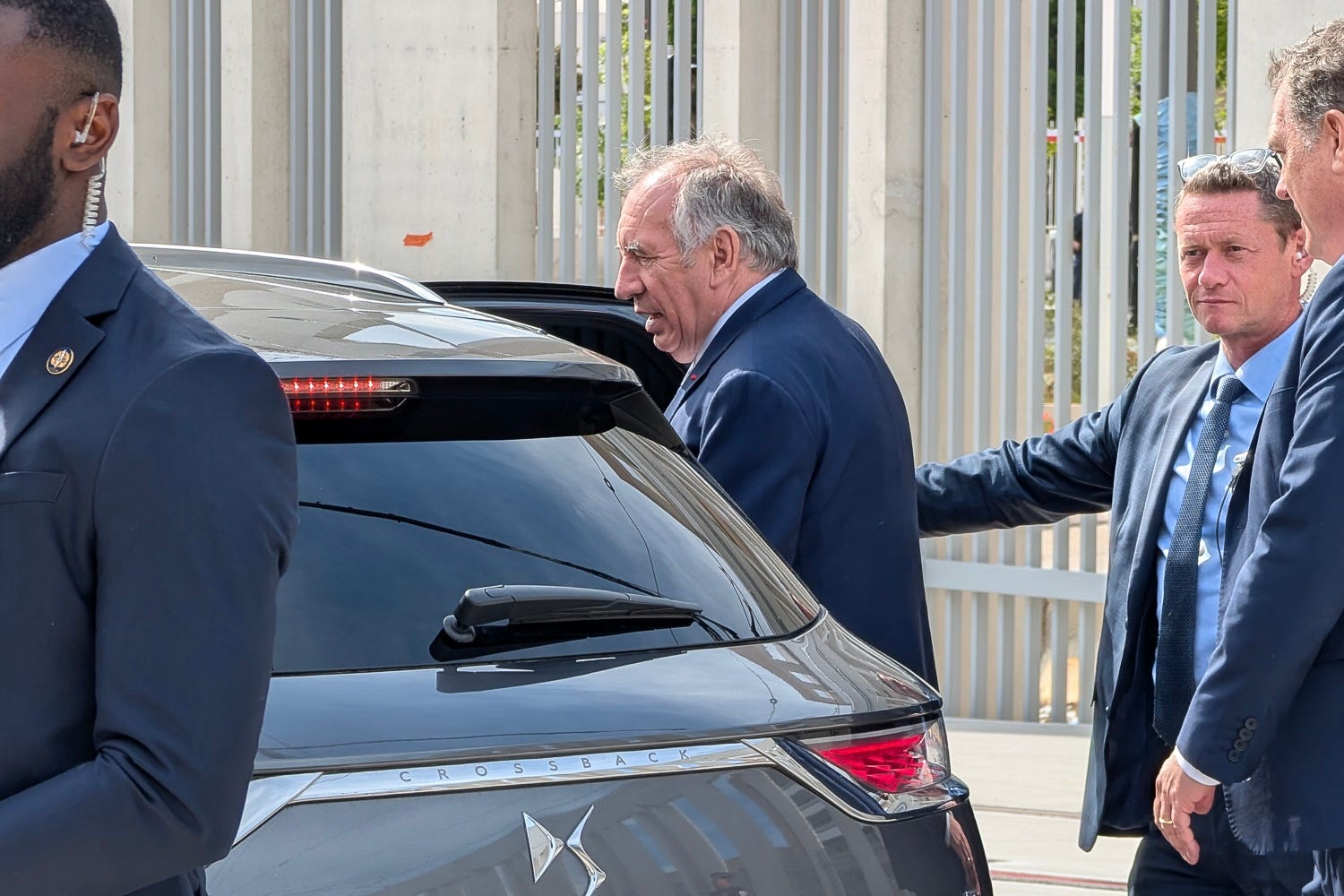
Bayr-out. Photo: here.
Bayrou’s fall
François Bayrou has always been an outsider. Third in the 2007 presidential elections, fifth in 2012, he retired in 2017 when he realized that a young banker named Emmanuel Macron could do better than him. And so he found himself managing his centrist party, composed of local dignitaries and little else. A judicial investigation (for the same offense for which Le Pen was convicted, embezzlement of European funds) prevented him from becoming Minister of Justice in 2017, so Macron placed him in the High Commission for Planning (better not to know what he did (or did not do) in that role). In any case, this Christian Democrat of yesteryear decided at the end of 2024 that his moment had come, that he had waited long enough, and that if Macron wanted to secure his support again, he would have to appoint him to the post-Barnier position. His imposition on the Élysée worked, and Macron gave up on appointing Sébastien Lecornu, at least for a while. During his months at Matignon, Bayrou managed to get the 2024 budget approved, with the votes of the PS and the RN, and to present a financial maneuver involving tears and blood. It was precisely this announcement (the maneuver included, among other things, the elimination of two public holidays) that sparked a huge popular reaction, which took the form of the Bloquons tout demonstrations on September 10. Bayrou, having removed his wait-and-see mask, decided to challenge Parliament. Through Article 49.1 of the Constitution, he requested a vote of confidence from the National Assembly (which he had not requested at the time of his inauguration, as there is no obligation to do so in France). Negotiations with the PS were not enough to save him from the vote of no confidence. End of the government (and of his political career? Not at all, he will run again for mayor of Pau).
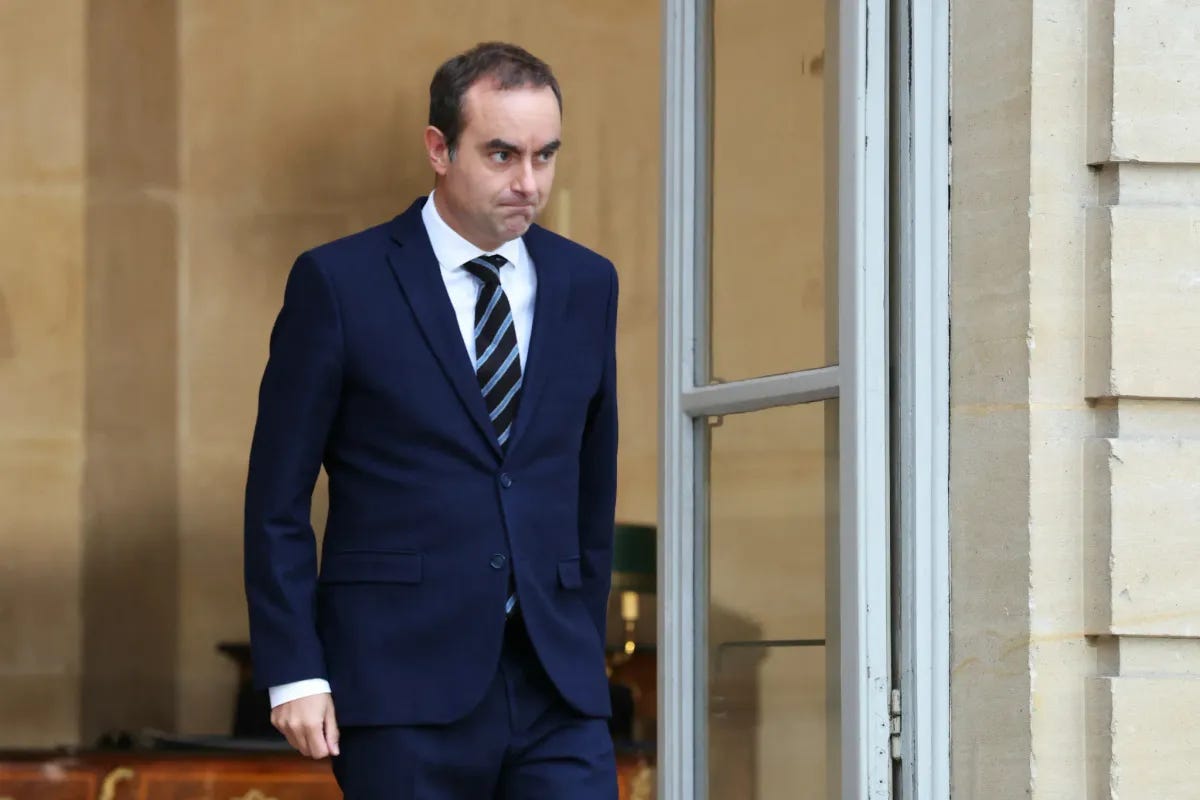
The government lasted so briefly that there isn’t even an official photo of the executive. Photo of Lecornu: here.
Lecornu’s nomination
The last two times, Macron took a long time before appointing a prime minister. This time, in no time at all, he decided to appoint Sebastien Lecornu, one of his most loyal supporters, formerly of LR, and one of the few to have played a role in the government team from 2017 to the present. As I mentioned, Macron already wanted to appoint him in December last year and, according to rumors, he agreed to give the new prime minister more room for maneuver. According to others, Macron appointed him on the eve of the big demonstration on September 10 to give the crowd an “enemy” other than himself. Lecornu took a month to form the new government and negotiate with the parties. He is said to be appreciated by both the right and the left. First of all, he announced that he would renounce the abolition of the two public holidays. Not only that, but in recent days he also declared that he would renounce the use of Article 49.3 and would therefore rely on the choices of Parliament. Nevertheless, given the political context and the upcoming presidential election (and the municipal elections even earlier, in March 2026), the parties have raised the bar of their demands. After a month of negotiations and talks, Lecornu announced his government. After a month of negotiations and talks, Lecornu announced his government. His government had TWELVE ministers who had already been part of the Bayrou government, plus the return of Bruno Le Maire, Minister of Economy until 2023, considered responsible for the collapse of French public finances, to the Ministry of the Armed Forces, and the reappointment of Retailleau to the Ministry of the Interior. Incidentally, the two former socialist ministers (let’s say the ‘left-wing’ component of the Bayrou government) were not reappointed. A government that changes (almost) nothing, so as not to change anything.
Since the announcement of the ministerial team, the situation has deteriorated rapidly. The Socialist Party made it clear that there was no alternative to censure, and yesterday morning the Republicans, who were also part of the government, announced their intention to withdraw from the government, sensing that the ship was sinking. This move made it impossible for the government to survive. Retailleau decided to leave the government to differentiate himself from Macron’s supporters ahead of 2027 and because, in his opinion, his party had been mistreated in the distribution of maroquins, or ministerial posts. Wauquiez, his internal opponent, said he was sorry that the government had left because of the distribution of posts and not because of the program. Acknowledging the failure of his government, Lecornu submitted his resignation to Macron, who agreed to end the most short-lived government in the history of the Fifth Republic.
Lecornu lasted 27 days as prime minister and his government only 13 hours. In a subsequent press conference, the former prime minister denounced “partisan appetites” while Retailleau accused him of hiding Bruno Le Maire’s presence among the ministers and reproached him for the lack of discontinuity with previous governments. A small bonus: this “government” cost French taxpayers €500,000 in allowances and privileges for former ministers. Pas mal.

Macron was spotted walking alone in Paris yesterday. A sign? Photo: here.
And now?
In Paris, the atmosphere is reminiscent of the final days of a reign. France finds itself suspended between paralysis and dissolution, with Emmanuel Macron increasingly isolated, a centrist bloc in tatters, and the National Rally poised to turn the crisis into an electoral coronation. After his brief resignation, Sébastien Lecornu was urgently recalled to the Élysée Palace. Macron entrusted him with a mission as vague as it is crucial: to conduct, by Wednesday evening, the final negotiations to define a “platform of action and stability for the country.” In other words, a desperate attempt to mend a central camp that has been worn down by months of tension, personal ambitions, and strategic differences. Yet Gabriel Attal, leader of Macron’s party, distanced himself from the president, stating that:
“I no longer understand the decisions of the President of the Republic, which give the impression of a sort of obsession with maintaining control. The president has tried the same thing three times in the last year. I think we could try something else.”
The game Lecornu has to play is impossible to win. If he manages to temporarily reunite the centrist front—bringing Ensemble, Horizons, MoDem, and LR back together and convincing a few moderate socialists to participate—Macron could still avoid the dissolution of the National Assembly. But if the attempt fails, his fate will be sealed. The Socialist Party has already said that there will be no alliance with LFI in the legislative elections, as it continues with the motion to impeach the President, and the Greens seem intent on following the same cautious line. The Communists remain an unknown quantity, but they are unlikely to be enough to compensate for the division on the left. In a new vote, the National Rally and its UDR allies appear to be in a position of strength, ready to impose a cohabitation unprecedented in recent political history. Macron, aware of the risk, “will take his responsibilities,” the Élysée Palace said, hinting that a new dissolution is already on the table. His resignation, on the other hand, remains an almost science fiction hypothesis: the man of the Élysée never gives up, even when the situation is desperate. Many in Paris whisper that the President’s real goal is another: to resist, to get through the possible cohabitation with the RN and to prepare, in the shadows, a political comeback for 2032. In the power vacuum that is opening up, only one thing is certain: the crisis is no longer a political accident, but the new normal for the Fifth Republic.
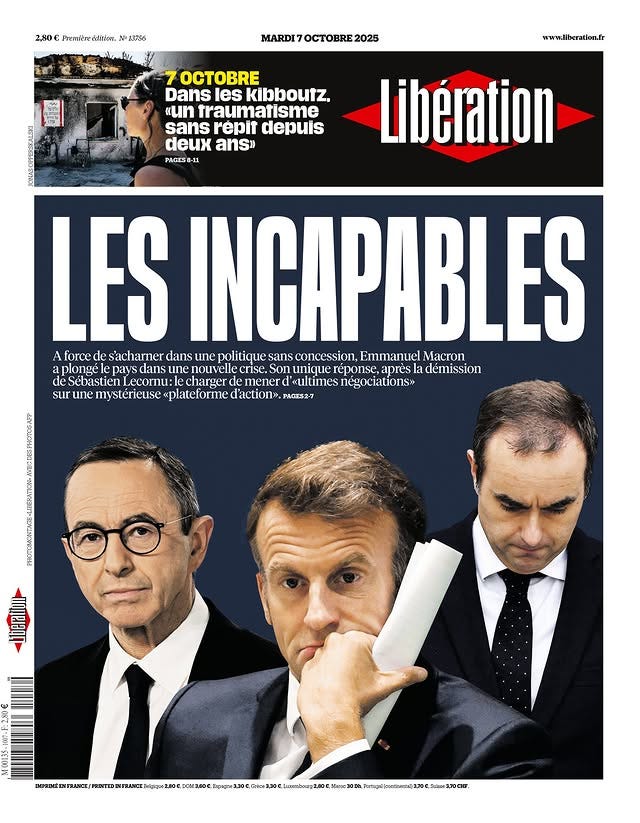
“The incompetents,” from left to right, Retailleau, Macron, and Lecornu. The headline in Libération.
Some additional information
The National Rally is close to 40% in the polls, including the hypothetical support of Zemmour and Dupont-Aignan. Whether it’s Marine Le Pen or Jordan Bardella, it doesn’t matter: the far-right bloc is now the favorite in every poll. C’est ce qu’on appelle un favori.
Nicolas Sarkozy sentenced to five years in prison for criminal conspiracy in the case of Libyan funding for the 2007 campaign. Following his conviction for corruption and the revocation of his Légion d’honneur, the former president will end up in prison.
During his very brief tenure at Matignon, Sébastien Lecornu suspended all new government communications spending until the end of 2025, except for healthcare and recruitment. In 2024, public communications cost €440 million.
In New York, Emmanuel Macron was stuck in traffic... because of Donald Trump. The police blocked Manhattan for the former US president’s motorcade, forcing the Élysée tenant to wait for over half an hour.
Brigitte and Emmanuel Macron will present scientific evidence that the Première dame was not born a man, following conspiracy theories relaunched by American commentator Candace Owens.
At the beginning of the summer, the Élysée Palace ordered huge rolls of paper—thirteen batches in total—to be used as ballot papers in case of emergency. Was this a technical precaution or presidential foresight?
Yaël Braun-Pivet, president of the National Assembly, in the August storm: according to Le Canard Enchaîné, the president of the National Assembly asked the police officers guarding her home to... feed her chickens.
Finally, a historic moment: France officially recognized the State of Palestine during the UN General Assembly in September.
This is the eleventh Oltralpe newsletter. Thank you for reading, see you next month. Don’t forget to share this newsletter and send me your feedback. À bientôt!